
Grieving Them While They're Still Here

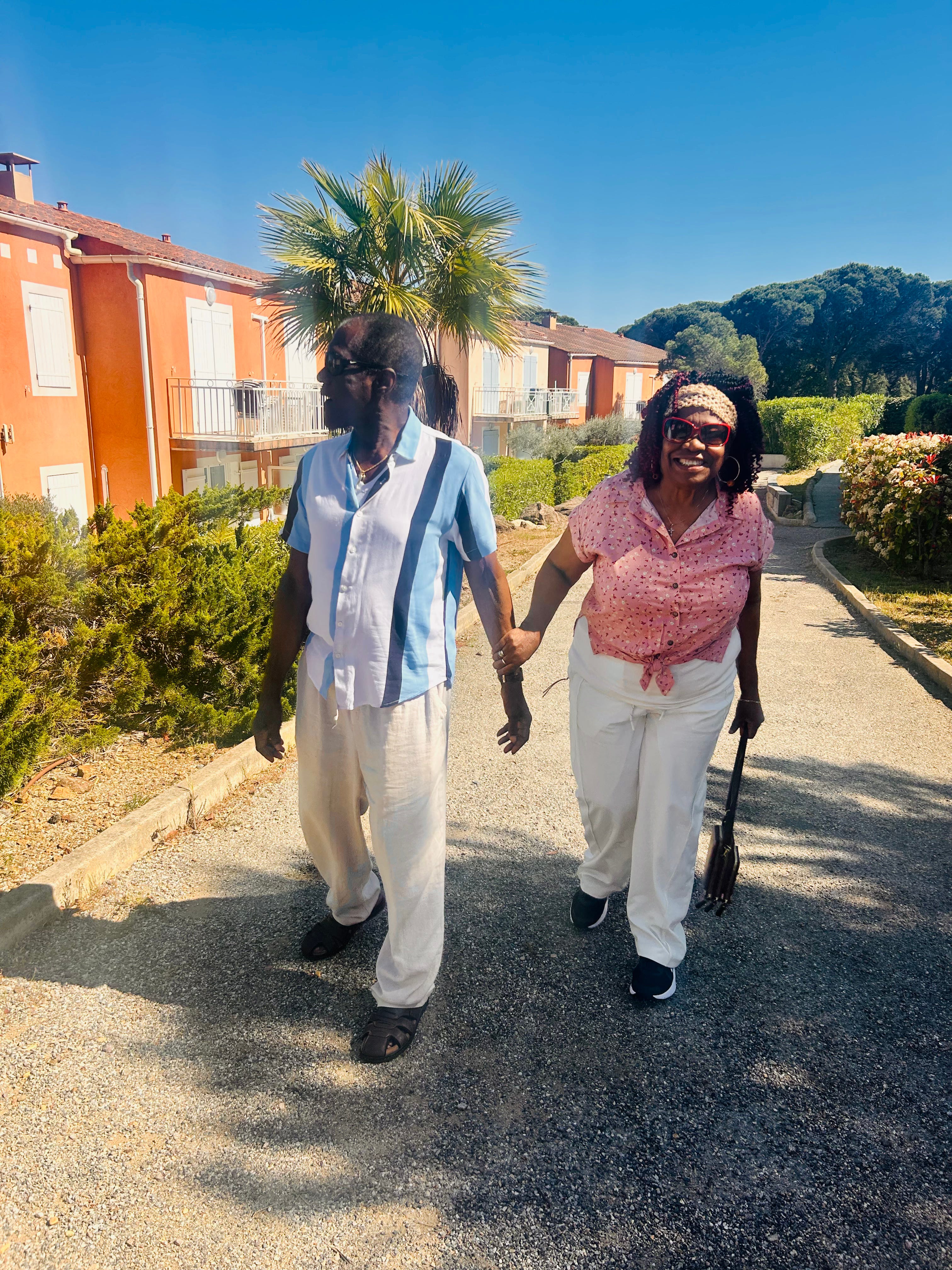
The first thing I noticed was my mother’s hand.
She was standing at the top of the escalator, and I watched her face privately calculate the negotiation with her body over something that used to ask nothing of her. Her hand found the rail and gripped it. She did not rest her hand on a surface out of habit. She gripped it like she needed it to be there. Her luggage, which she had rolled herself every other moment of the trip, could not also be held. There was not enough steadiness for both. My spouse and I noticed. After that, without drawing attention to it, he became the person who took her bag when we were nearing escalators so she could be steady. That simple transfer, that seemingly small act of love that required nothing of her pride, happened over and over through the whole trip. And every time I watched it, I felt something in my chest fracture open with zero sign of closing.
My father watched this too, and moved to help the way he always has, calm and determined and steady in his tone, the voice of a man who has rarely let us see him rattled. He insisted he had things. He always insists he has things. But I was cataloguing him now. I watched the way heavy bags took something from him that they didn’t used to take. How I constantly considered if he was carrying too much and I could see it even while he would not say it. Then there was the bus. Getting off, the steps steep and narrow the way bus steps are, he lingered his hand on the railing. Twenty seconds longer than I expected. I counted without meaning to. There was no stumble, it was just a man taking the stairs with a new kind of attention. I silently knew, while the rest of him was still unwilling to announce it. The overhead luggage, which he would have lifted in one motion years ago, took him a few minutes. These in-between nothing moments, a hand on a rail, a bag passed to a son-in-love, a breath taken before a lift, were accumulating in my mind like evidence I had not asked to collect and could not stop gathering.
This is the thing about loving parents who have aged beautifully. The beauty becomes a kind of protection, and the protection becomes a kind of lie. The lie isn’t cruel, just the lie your love tells itself so you can keep moving through the world without the weight of what’s coming.
My parents are stunning people. They have carried their years with a grace I have spent most of my life filing under the category of just who they are, the same way I filed the sun under the category permanent. And France undid that filing. Gently, specifically, without warning, in the space of an escalator and a bus step and a bag passed between hands.
They move differently now, more deliberate, more negotiated. They move the way people move when the body has begun to have a conversation with time. I noticed these things the way I noticed weather, which is to say it was constantly, which is to also say I could not stop. Some vacations are just vacations. This one was a threshold. Maybe not the last trip we ever take together, but the last one that looks exactly like this: most of us (sans my brother), this configuration, this version of my parents who can still do this, who are still here and present and bringing us to the French Riviera for an epic vacation and my milestone birthday. The Mediterranean received us and I received it and underneath all of that receiving was a grief that was a whisper. It took me days to put it into words.
I am learning to grieve them while they are still living.
This isn’t morbid. I have had to convince myself of that more than once, because the instinct is to call it morbid and put it away, to say I am borrowing trouble, to say I should be grateful for what I have instead of mourning what I will lose. And I am grateful, so grateful the birthday dinner at that table in Saint-Raphaël with those people felt like something I was both inside and witnessing from a holy distance.
But gratitude and grief are not enemies.
They are the same love wearing different faces, and I am old enough now, just turned forty, to understand that grieving them early is not giving up on them. It is the most honest thing I can do with how much I love them.
Every year I get older is one more year of me standing closer to a reality I cannot think about for too long without having to put something down and breathe. My parents will not always be here. The escalator told me that. The bus step told me that. The bag, passed without a word, told me that. And instead of looking away, I looked. I kept looking. I made a study of them the whole trip, the way they laughed at dinner, the way my mother held her glass, the specific timbre of my father’s voice when he was relaxed and happy and in a place that delighted him. I collected them. I am still collecting them.
Because when the inevitable truth arrives at my door, I want to have already done this work. I want to have already sat with the ache of their aging and let it make me more present, more deliberate, more awake in every ordinary moment I still get to share with them. I want to grieve in the way that opens, rather than closes. A grief that is just love with nowhere else to go, so it goes deeper…and makes more room.
The France trip was a gift. So was the hand on the rail. So is all of it, the slowness, the new care, the evidence of time doing what time does to the people we love most. I am learning to hold it without recoiling. I am learning to look directly at the light.
i relate to this so so much. i had the same experience with my mother before she passed, and now with my father as he's in failing health as well. ❤️🩹
This hits home on many levels!